Every Business Gets Paid Differently.
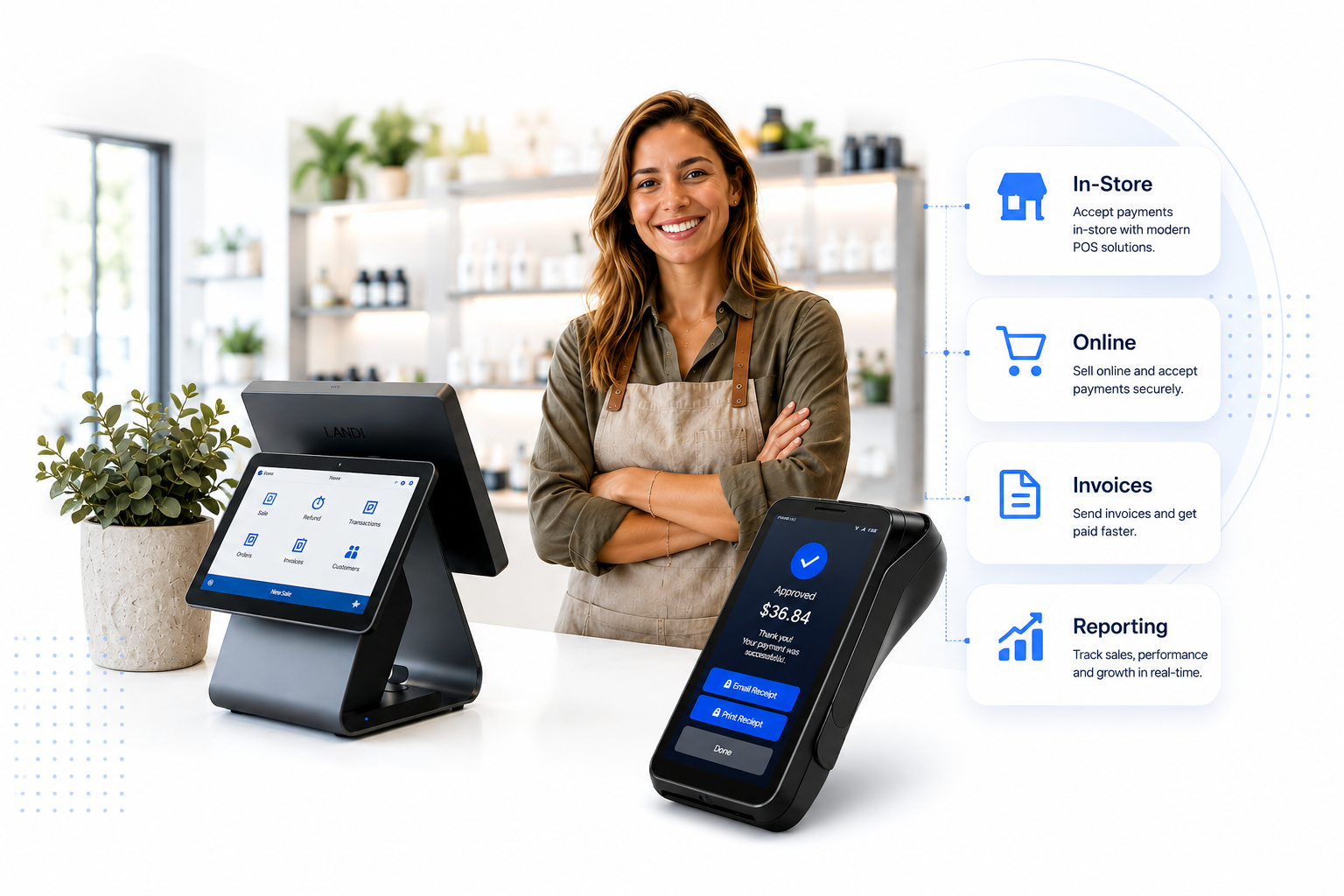
Find the payment processing solution built around how your business accepts payments—from in-store checkout and ecommerce to invoices, subscriptions, mobile payments, and everything in between.
How Does Your Business Get Paid?
Every business accepts payments differently. Choose the path that best matches how your customers pay today.
Retail
POS systems, terminals, customer displays, loyalty, inventory, and in-person checkout.
View In-Person Options →eCommerce
Online checkout, shopping carts, payment links, and secure website payments.
Explore Online Payments →Mobile & Tap To Pay
Accept payments on the go with Tap to Pay, wireless terminals, and mobile checkout.
See Mobile Solutions →Invoicing
Send invoices, key payments, accept phone orders, and get paid remotely.
Explore Invoicing →Payment Gateway
Gateway integrations, hosted payment pages, virtual terminals, and secure payment tools.
View Gateway Options →Recurring Billing
Subscription billing, memberships, card-on-file payments, and recurring revenue.
Explore Recurring Billing →
Remove Friction.
Increase Revenue.
Businesses that rely on a single way to accept payments often create unnecessary friction for customers and unnecessary limitations for themselves.
Modern payment strategies aren't about accepting more card types. They're about removing barriers to getting paid.
Meet Customers Where They Are
Today's customers expect flexibility. Whether they're shopping in-store, paying an invoice, tapping a phone, or checking out online, making payment easy removes friction and helps close more sales.
One Platform. Every Channel.
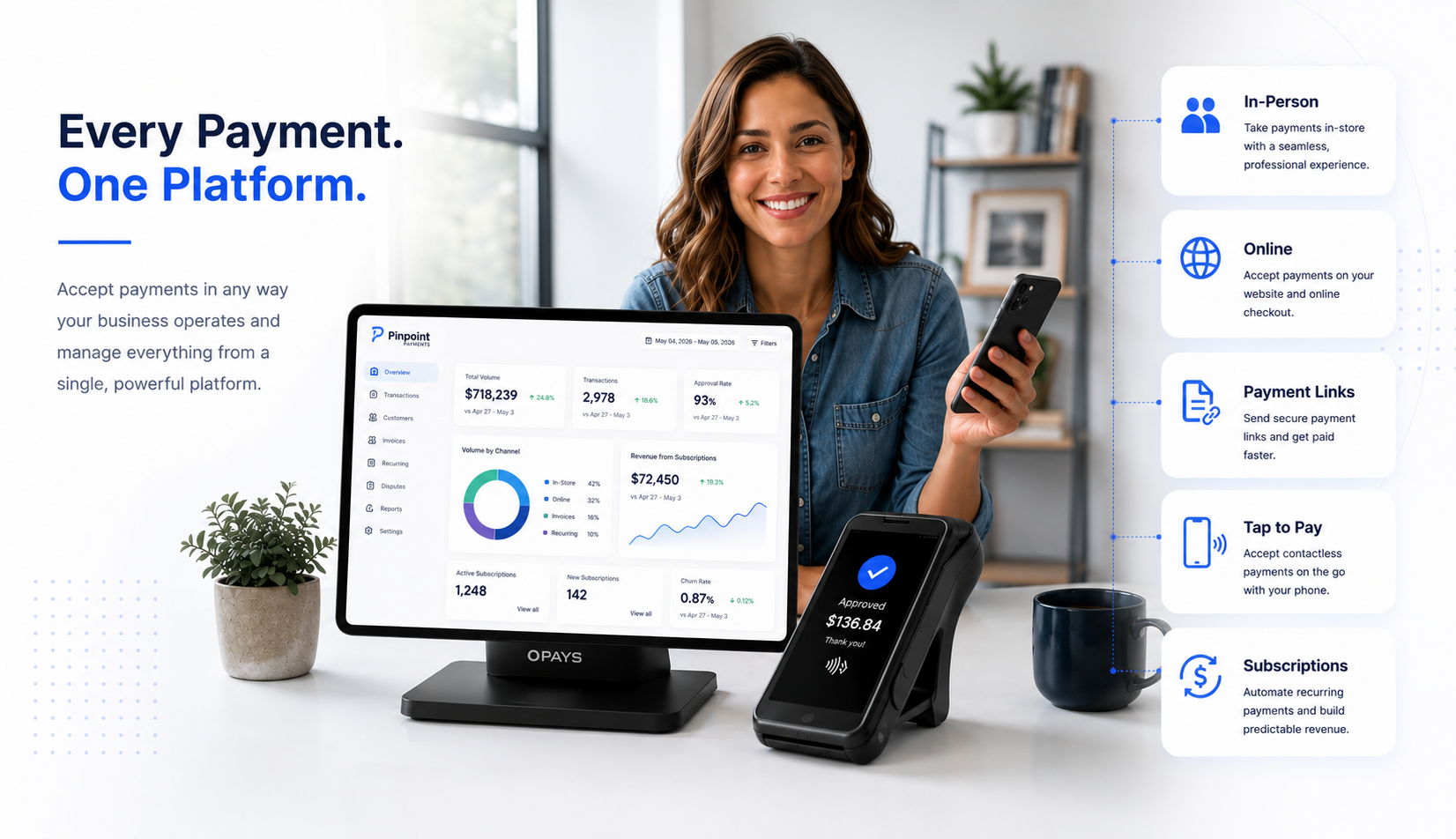
Bring your in-store, online, mobile, invoicing, and recurring payments together under one provider for simpler operations and better visibility.
Built To Grow With You
Start with the payment methods you need today, then add ecommerce, recurring billing, mobile payments, or additional locations as your business grows.
Turn Payments Into An Advantage
Payment technology should do more than process transactions. The right platform improves cash flow, simplifies operations, and creates a better customer experience.
Trusted by Business Owners Everywhere
The best partners help your business grow. Since 2013, Pinpoint Payments has helped businesses streamline operations, reduce unnecessary costs, expand into new payment channels, and navigate the challenges that come with accepting payments.
Recognized nationally for outstanding customer service delivered daily by our US based operations team.
Continue Exploring Payment Solutions
Find the technology, services, and guidance your business needs to accept payments, improve performance, and prepare for growth.
Accept Payments
Explore solutions based on where and how your customers pay.
Optimize Payments
Improve costs, risk management, approvals, and performance.
Payment Processing FAQs
What is payment processing?
Payment processing is the system that allows a business to accept electronic payments from customers. It securely connects the payment method, merchant account, card network, payment processor, and customer’s bank so the transaction can be authorized, settled, and deposited into the business’s bank account.
What is the best way for a business to accept payments?
The best way to accept payments depends on how and where the business sells. Retail stores may need a POS system and countertop terminals, while contractors may benefit from Tap to Pay, mobile terminals, invoices, and payment links. Ecommerce businesses generally need an online checkout and payment gateway, while membership and subscription businesses often require recurring billing.
Many businesses benefit from using several payment methods rather than relying on a single checkout option.
What types of payment solutions are available for businesses?
Businesses can accept payments through:
- Retail POS systems and countertop terminals
- Ecommerce checkout and shopping-cart integrations
- Mobile terminals and Tap to Pay
- Virtual terminals and phone payments
- Digital invoices and payment links
- Payment gateways and hosted payment pages
- Recurring billing and subscription payments
- ACH and electronic check payments
- Card-on-file and stored-payment capabilities
The right combination depends on the business model, customer experience, and operational needs.
How do I choose the right payment solution for my business?
Start by identifying where transactions occur and how customers prefer to pay. Consider whether your business accepts payments in person, online, over the phone, in the field, through invoices, or automatically on a recurring schedule.
You should also consider your industry, average ticket size, monthly volume, software integrations, reporting needs, equipment requirements, and future plans. A payment solution should support the way your business operates today while allowing you to add new payment channels as you grow.
Can one payment processor handle in-person, online, mobile, and recurring payments?
Yes. A single payment provider can often support in-person payments, ecommerce, mobile payments, virtual terminals, invoices, payment links, and recurring billing.
Using one provider for multiple payment channels can simplify reporting, reconciliation, customer support, equipment management, and day-to-day payment operations. The available functionality depends on the payment platform, gateway, software integrations, and merchant account.
What is the difference between a POS system, payment gateway, and virtual terminal?
A POS system is primarily used for face-to-face transactions. It may also include inventory, customer management, employee controls, loyalty, invoicing, and reporting.
A payment gateway securely connects a website, shopping cart, mobile application, or software platform to the payment processor for online transactions.
A virtual terminal allows a business to securely enter payment information through a web browser. It is commonly used for phone orders, remote payments, invoicing, and card-on-file transactions.
Do I need a POS system or just a credit card terminal?
A basic credit card terminal may be sufficient when a business only needs to accept in-person card payments.
A POS system is generally more appropriate when the business also needs inventory management, barcode scanning, customer profiles, loyalty, employee permissions, appointments, invoicing, detailed reporting, or multiple-location management.
Do I need a payment gateway to accept payments online?
Generally, yes. A payment gateway securely transmits transaction information between the business’s website or e-commerce platform, the payment processor, the card networks, and the customer’s bank.
Some hosted checkout pages, e-commerce platforms, and payment-link solutions include gateway functionality as part of the service. Those are considered payment platforms and offer less control over the process itself.
What is Tap to Pay, and can I accept payments with my phone?
Tap to Pay allows a compatible smartphone to accept supported contactless cards and digital wallets without a separate card reader.
It can be useful for contractors, field-service businesses, events, pop-up stores, delivery businesses, mobile sales teams, and merchants that need an additional checkout option. Device compatibility and supported payment methods depend on the selected platform.
How can a business accept payments over the phone or remotely?
Businesses can accept remote payments through a virtual terminal, digital invoice, payment link, hosted payment page, or secure card-on-file system.
A virtual terminal is commonly used when an employee needs to enter payment information for a phone order. Invoices and payment links allow customers to enter their own payment details through a secure checkout page.
Can businesses send invoices and payment links to customers?
Yes. Businesses can send digital invoices and secure payment links by email or text, allowing customers to pay from a phone, tablet, or computer.
These options are especially useful for contractors, professional services, B2B companies, medical offices, field-service businesses, and merchants that do not collect every payment at a traditional checkout counter.
What is recurring billing?
Recurring billing automatically charges a customer on an agreed schedule using a securely stored payment method.
It is commonly used for subscriptions, memberships, service plans, retainers, installment arrangements, maintenance programs, and other repeat-payment models.
Recurring billing can reduce manual invoicing and create more predictable payment collection.
Why should a business offer more than one way to pay?
Customers do not all prefer the same payment experience. One customer may want to pay at a counter, another through an online checkout, and another through an invoice or payment link.
Offering multiple payment channels can reduce friction, improve customer convenience, shorten collection times, and help prevent sales from being delayed because the customer’s preferred payment option is unavailable.
What payment solutions work best for contractors and field-service businesses?
Contractors and field-service businesses often benefit from a combination of:
- Tap to Pay
- Wireless payment terminals
- Digital invoices
- Payment links
- Virtual terminals
- Card-on-file payments
- Recurring billing
This combination can allow the business to collect deposits, accept payments on-site, charge approved cards on file, and send final invoices after the work is completed.
What payment solutions work best for retail businesses?
Retail businesses typically benefit from a POS system that combines payment processing with the operational tools required at checkout.
Depending on the business, this may include countertop terminals, customer-facing displays, receipt printers, barcode scanners, inventory management, loyalty, employee controls, multi-location reporting, and ecommerce integrations.
What payment solutions work best for ecommerce businesses?
Ecommerce businesses generally need a secure payment gateway that is tied into their website checkout page or shopping-cart through an API or plug-in. Many times, it's a few simple steps to get setup. Fraud tools, tokenization, card-on-file functionality, and reporting are things to ensure are included.
Businesses selling subscriptions or memberships may also need recurring billing, while businesses with higher dispute exposure may benefit from chargeback alerts, 3D Secure, and additional fraud-prevention tools.
Can I start with one payment method and add others later?
Yes. A business may begin with a countertop terminal, mobile payment solution, virtual terminal, or ecommerce gateway and add other capabilities later.
For example, a retail business may add ecommerce, a contractor may add recurring service plans, or an online business may add an in-person sales channel. Choosing a scalable provider can make this expansion easier without requiring the business to replace its entire payment setup.
Can I switch payment processors without replacing all of my equipment or software?
Sometimes. Whether existing equipment and software can be retained depends on device compatibility, ownership, encryption, gateway connections, processor certifications, and the current provider’s configuration.
A payment review can determine which parts of the existing setup can remain, which can be reprogrammed, and which may need to be replaced or integrated differently.
What should I look for when choosing a payment processor?
Businesses should evaluate more than the advertised processing rate. Important considerations include:
- Support for the payment channels the business needs
- Equipment and software compatibility
- Funding terms and deposit timing
- Contract length and cancellation terms
- Customer support and onboarding
- Reporting and reconciliation
- Fraud and chargeback tools
- PCI compliance support
- Industry experience and underwriting capabilities
- Ability to add new payment channels as the business grows
The best provider should recommend a solution based on the business model rather than forcing every merchant into the same platform.
What makes Pinpoint Payments different?
Pinpoint Payments builds payment solutions around how each business actually operates. Since 2013, our team has supported in-person, ecommerce, mobile, invoicing, recurring, B2B, and specialized payment environments.
Businesses receive hands-on onboarding, U.S.-based support, access to multiple payment technologies, risk and chargeback guidance, and a scalable setup designed to support both current needs and future growth.
Let's Build the Right Payment Solution for Your Business.
Not every business accepts payments the same way. Tell us a little about your business, and we'll recommend a payment solution built around how you actually get paid.