Payment Processing for Smoke Shops and Vape Stores: What Owners Need to Know

Nico Ruggieri
Nov 16, 2026
11 min read
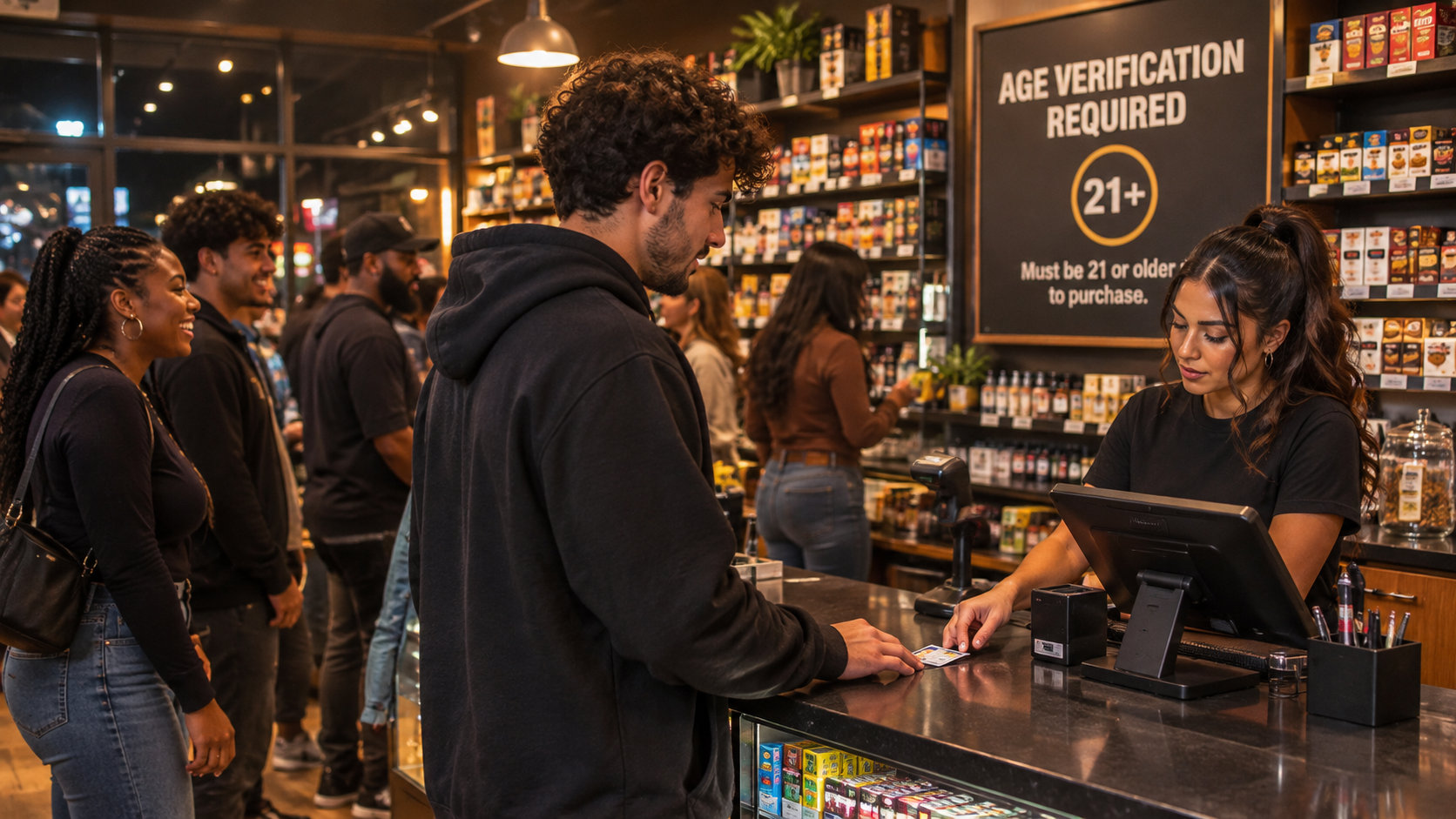
It's 9:40 on a Friday night. The line is out the door, and a customer who looks about 24 slides an ID across the counter.
Your employee is responsible for making sure the customer is legally allowed to make the purchase.
You're not there. You trained them, you established the policy, and you put the sign on the wall.
Now that policy has to work without you.
That's one of the things that makes running a smoke shop different from most retail businesses.
You're managing age-restricted products, inventory, employees, regulatory requirements, processing costs and customer relationships. And if you own multiple locations, you're managing all of those things across multiple stores.
That's why payment processing for smoke shops and vape stores should be about more than putting a credit card terminal on the counter.
Your payments and retail technology should fit the business you're actually running.
Can Smoke Shops and Vape Stores Accept Credit Cards?
Yes. Smoke shops and vape stores can accept credit and debit cards through payment processors and acquiring banks that support their products and business models.
The important thing is finding a merchant account that supports your full product mix and the way you sell.
A traditional tobacco retailer may have different underwriting requirements than a vape store, a smoke shop carrying hemp-derived products or a business selling online.
Before opening a merchant account, make sure your provider understands what you sell today, where you sell it and what you plan to add in the future.
Getting approved to accept credit cards is only the first step. Understanding exactly what your account has been approved to support is equally important.
Are Smoke Shops and Vape Stores Considered High-Risk Merchants?
Not automatically.
Smoke shops and vape stores operate in regulated industries, but how a business is classified depends on the processor, acquiring bank, products, sales channels and overall risk profile.
A licensed storefront where customers pay in person presents different underwriting considerations than an ecommerce business shipping vape products across state lines.
Adding CBD, kratom or hemp-derived products can introduce additional considerations.
When evaluating a smoke shop merchant account, a payment provider may look at:
- The products being sold
- Required business and retail licenses
- In-person versus online sales
- Expected processing volume and average transaction size
- Previous processing and chargeback history
- Business ownership and operating history
- Applicable regulatory requirements
The goal isn't to find a processor that simply accepts smoke shops.
It's to find one that understands your particular smoke shop.
Why Do Some Payment Processors Not Support Smoke Shops?
Different payment processors and acquiring banks have different policies regarding regulated products.
One provider may support traditional tobacco retail but have restrictions on certain vape or hemp-derived products. Another may support in-person sales but not online orders.
Some may require additional documentation, underwriting or card-network registration.
A product being legal to sell doesn't automatically mean every payment provider will support it.
That's why it's important to work with a provider that has experience in your industry and understands the distinctions between different products and business models.
You shouldn't have to discover those distinctions after you've already opened your account.
How Much Does Credit Card Processing Cost for a Smoke Shop?
Credit card processing costs for smoke shops vary depending on the merchant account, pricing structure, product mix, sales channel and underwriting requirements.
There isn't one universal smoke shop processing rate.
When comparing providers, look beyond the advertised percentage.
Understand your total cost, including:
- Credit and debit card processing fees
- Monthly account fees
- Equipment and POS software costs
- Transaction and authorization fees
- Any applicable card-network registration or specialty-program fees
- Chargeback-related fees
- Contract terms and cancellation fees
- Reserve requirements, if applicable
Certain regulated-product categories or sales channels may require additional registration or carry additional fees. Ask your provider whether those requirements apply to your business, who handles them and what they cost.
Also consider what you're paying for outside of payment processing.
If you're paying separately for your POS, inventory software, employee management, loyalty program and reporting tools, those expenses are part of the cost of operating your store.
The lowest advertised processing rate doesn't necessarily mean the lowest overall cost.
Can Smoke Shops Use Dual Pricing to Reduce Processing Costs?
Yes. Eligible smoke shops and vape stores can use properly structured dual pricing programs to offer separate cash and card prices.
For retailers looking to manage payment acceptance costs, dual pricing can be an alternative to traditional processing pricing.
But how the program is implemented matters.
Dual pricing, cash discounts and credit card surcharges aren't interchangeable. Each has its own considerations, and programs must comply with applicable laws and card-network requirements.
The pricing should be clearly communicated to customers, reflected correctly at checkout and accurately represented on receipts.
Your POS and payment system should work together so employees aren't manually calculating price differences or explaining inconsistent totals at the register.
Ask your payment provider which pricing options are available, how they work and whether they make sense for your business.
The right solution should help you manage costs without creating unnecessary confusion for customers or employees.
What Happens If You Add CBD, Kratom or Hemp-Derived Products?
Many smoke shops carry more than traditional tobacco and vape products. Each additional product category can introduce different legal requirements, licensing considerations and payment-processing policies.
Before adding a new regulated product category, confirm two things:
First, whether the product can legally be sold in your jurisdiction.
Second, whether your existing merchant account supports it.
Those are separate questions.
Your payment processor's approval isn't a substitute for determining whether a product is legally permitted, and a product's legal status doesn't guarantee that your processor will accept it.
Regulations and acquiring-bank policies can also change over time.
Make sure your payment provider knows your full product mix, and ask how you'll be notified if a policy changes for something you carry.
Adding a new product shouldn't mean discovering later that your merchant account wasn't approved to support it.
What Are the Age Verification Requirements for Smoke Shops?
Federal law prohibits the sale of tobacco products, including e-cigarettes, to anyone younger than 21.
Under FDA regulations, retailers must verify the age of tobacco purchasers under 30 using photo identification. This requirement took effect on September 30, 2024. State and local requirements may also apply.
Knowing the rule is one thing.
Making sure it's followed consistently across every employee, shift and location is another.
The FDA conducts compliance inspections and may issue warning letters, impose civil money penalties or pursue no-tobacco-sale orders. State and local authorities may have additional enforcement mechanisms, including penalties affecting retail licenses.
That's why age verification shouldn't depend entirely on whether an employee remembers the store's policy during a busy shift.
It should be built into the way the store operates.
How Can a POS System Help Smoke Shops With Age Verification?
A point-of-sale system with integrated age-verification capabilities can help store owners establish and enforce more consistent checkout procedures.
Depending on the system, owners can:
- Configure age verification as mandatory or optional
- Scan customer identification at checkout
- Control when a manager override is permitted
- Review age-verification activity through an audit trail
- Manage employee permissions
That gives owners more visibility into what happens at the register, even when they're not physically in the store.
If you're managing multiple locations, it also helps establish a more consistent process across your business.
Technology doesn't guarantee legal compliance. ID scanning doesn't replace the need to examine identification appropriately, train employees or follow applicable laws.
But the right technology can help reinforce the procedures you've established.
You can't stand behind every register. Your operating procedures should still be working when you're not there.
Does Selling Tobacco or Vape Products Online Change Your Payment Processing?
Yes.
Selling online introduces different underwriting, fraud, fulfillment and regulatory considerations than accepting payments inside a physical store.
The federal PACT Act also establishes requirements for certain tobacco and vape sales and shipments, including cigarettes, smokeless tobacco and electronic nicotine delivery systems.
Depending on the activity, requirements can include registration, reporting, age verification, delivery procedures and recordkeeping. Mailing restrictions and state or local rules may also apply.
From a payments perspective, don't assume your existing retail merchant account automatically supports ecommerce or delivery.
Before adding a new sales channel, ask your processor whether it is supported, whether additional underwriting is required and whether you'll need a separate merchant account or payment configuration.
Work through the applicable legal requirements before launching.
Expanding your business shouldn't mean discovering after the fact that your existing payments setup doesn't support the new sales channel.
What Should a Smoke Shop POS System Include?
A smoke shop POS system should do more than ring up sales and accept payments.
Think about how much happens inside your store on any given day.
New inventory arrives. Employees change shifts. Products sell out. Prices change. Customers return. Cash drawers need to be reconciled. Someone needs to figure out what to reorder.
If those activities are spread across disconnected systems, running the business can become more complicated than it needs to be.
When evaluating a POS system for your smoke shop or vape store, look for capabilities that support the way you operate.
Inventory management
Track products, variations, stock levels, suppliers, purchase orders, low-stock items and inventory adjustments without relying entirely on spreadsheets or manual counts.
Integrated age verification
Establish checkout procedures for age-restricted sales, control overrides and review verification activity.
Employee management
Manage permissions, track employee activity, manage shifts and review discounts, refunds and other register activity.
Integrated payments and pricing
Accept payments directly through your POS, manage supported pricing programs and keep transaction records together.
Customer management and loyalty
Manage customer relationships and eligible loyalty programs within the same system, subject to applicable product and marketing restrictions.
Reporting and multi-location management
Understand what is selling, what isn't, how stores are performing and where inventory or operational issues may need attention.
The goal isn't to have the longest list of software features.
It's to spend less time managing software and more time managing your business.
How Do You Manage Payments and Inventory Across Multiple Smoke Shop Locations?
Opening a second location shouldn't necessarily mean doubling the number of systems you manage.
But when each store operates independently, it can become difficult to answer relatively simple questions.
Which location is running low on inventory?
Which products sell better at one store than another?
Are employees following the same procedures?
Why are refunds or discounts higher at one location?
What are my total sales across the business?
How much am I paying to accept payments overall?
A centralized POS and payments environment can help owners manage inventory, reporting, employees and store performance without constantly switching between disconnected tools.
Your payment provider should also understand your ownership structure, locations, product mix and reporting needs.
Ask whether you can access your locations through a centralized platform and how additional stores will be set up as your business grows.
The technology that works for one store should also be considered in the context of the business you're building.
Do You Need to Change Your POS If You Change Payment Processors?
It depends on your existing POS system, equipment and processing agreement.
Some POS systems work with multiple payment providers. Others are tied to a particular processing platform.
Before signing an agreement, understand whether your hardware and software can continue working if your payment-processing relationship changes.
Also ask what happens to your inventory, customer records and historical reporting if you decide to move to a different system.
If you're considering a new POS, find out what existing data can be imported rather than assuming everything needs to be rebuilt manually.
For a smoke shop with thousands of products, switching systems involves much more than replacing a terminal.
Your inventory, operational data and ability to continue running your store should be part of the conversation.
What Should You Ask a Payment Processor Before Opening a Smoke Shop Merchant Account?
For more than 13 years, we've worked with businesses across high-risk and regulated industries.
If we were evaluating payment processing for a smoke shop or vape store, these are the questions we would want answered:
- Have you worked with smoke shops and vape retailers before?
- Does my merchant account support everything I currently sell?
- What happens if I add a new regulated product category?
- Are there additional card-network registration requirements or fees?
- What is my total processing cost, including software and equipment?
- Do you offer traditional processing and compliant dual pricing options?
- Can you support additional locations, ecommerce or delivery if my business expands?
- What age-verification and employee-control capabilities are available?
- Can I manage payments, inventory and reporting within one platform?
- What happens to my equipment and data if I change providers?
- How will I be notified about changes that affect my account?
- Who do I call when something goes wrong?
How a provider answers those questions tells you considerably more about the relationship than an advertised processing rate alone.
How Pinpoint Payments Helps Smoke Shops and Vape Stores
At Pinpoint Payments, we believe payment processing should be built around the business, not the other way around.
For smoke shops and vape stores, that means understanding the products you sell, your regulatory environment, your processing needs and the challenges that come with operating a specialty retail business.
Our approach goes beyond helping merchants accept credit cards.
We bring together payment processing and retail technology with capabilities including inventory management, configurable age verification, employee controls, reporting, multi-location management, dual pricing and eligible customer loyalty tools.
Rather than managing payments in one system, inventory in another and employee activity somewhere else, retailers can bring more of their daily operations together.
Whether you're opening your first smoke shop, replacing an outdated POS system, reviewing processing costs or expanding into additional locations, the conversation should start with how your business actually operates.
Because you're not just accepting payments.
You're running a store, managing people, protecting your inventory and building a business.
Your payment provider should understand all of that.
Contact Pinpoint Payments to discuss merchant account and point-of-sale solutions for your smoke shop or vape store.
Frequently Asked Questions
Can smoke shops and vape stores accept credit cards?
Yes. Smoke shops and vape stores can accept credit and debit cards through payment providers that support their product mix and business model. Merchants should confirm that their account is approved for the products and sales channels they use.
Are smoke shops considered high-risk merchants?
Not automatically. Classification depends on the processor, acquiring bank, products, sales channels, processing history and other underwriting considerations. A traditional retail smoke shop may have different requirements than an online vape retailer.
What is the best payment processor for a smoke shop?
The best payment processor for a smoke shop is one that understands regulated retail, supports the merchant's approved product mix, offers transparent pricing, provides reliable account support and can accommodate the store's operational and technology needs.
Do smoke shops pay higher credit card processing fees?
Some smoke shops may have additional fees or underwriting requirements depending on their products, sales channels and acquiring program. However, there isn't a universal processing rate for smoke shops. Merchants should compare their total cost rather than relying on an advertised rate alone.
Can vape stores use dual pricing?
Yes, eligible vape stores can use properly structured dual pricing programs where permitted. The program must comply with applicable laws and card-network requirements, and customers should clearly understand the available prices before completing the purchase.
Do smoke shops have to check ID for every sale?
Federal requirements prohibit tobacco sales to anyone younger than 21 and require photo identification to verify the age of tobacco purchasers under 30. Additional state, local or store-specific requirements may apply.
Can a smoke shop POS system scan IDs?
Yes. Some smoke shop POS systems offer integrated ID scanning, configurable age-verification requirements, manager overrides and audit trails. These tools can support consistent store procedures but do not guarantee legal compliance.
Can I sell CBD, kratom or hemp products through my smoke shop merchant account?
It depends on the specific products, applicable laws and the acquiring bank's policies. Confirm that the products can legally be sold and that your merchant account supports them before accepting payments for them.
Can I manage multiple smoke shop locations through one POS system?
Yes. POS platforms with multi-location capabilities can help owners centrally manage inventory, reporting, employee permissions and store performance. Confirm what information and payment reporting can be accessed across locations before selecting a provider.
Can I use my smoke shop merchant account to sell vape products online?
Not necessarily. Online vape sales introduce separate underwriting and regulatory considerations. You should confirm that your payment provider supports online sales and that your business meets the applicable legal requirements before launching.
What should I look for in a smoke shop POS system?
Look for integrated payments, inventory management, age verification, employee permissions, reporting, purchase orders, pricing flexibility and multi-location management where applicable. The system should support how your business operates rather than forcing you to rely on multiple disconnected applications.